

- Install
- 5.3 K
- 13
- 4.8
- Category
- Music & Audio
- Last updated
- 2026 November 8
- Size
- 27 MB
View antivirus results
checking the app
App screenshots


About this app
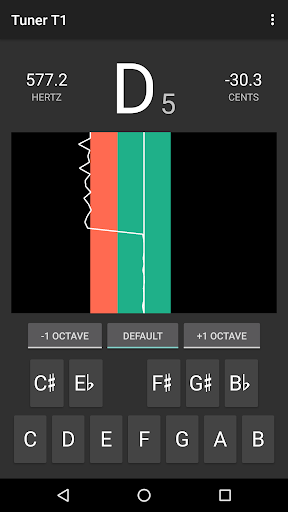
Tuner T1 is a chromatic tuner for guitar, ukulele, violin, viola and cello. Play one note at a time and follow the live note, frequency and cents readings. A pitch-history graph and audible reference tones give you two more ways to compare what you play.
Tuning guitar, ukulele, violin, viola and cello
Use Tuner T1 as a guitar tuner or ukulele tuner to check each string after changing strings or before you play. As a violin tuner, viola tuner or cello tuner, it lets you watch the pitch of an open string as you sustain the note. Follow the cents reading to see how far the pitch is from the detected note.
Follow changes over time
A single reading captures one moment. The pitch-history graph shows how a held note changes, so you can watch the trace while making a small adjustment. Continuous display options let you choose how the history is presented. This is useful for comparing the beginning of a note with its sustained sound and for noticing movement as the sound settles.
Hear a reference note
The reference-tone keyboard contains the 12 chromatic notes, with three selectable octave positions. Play a reference tone and compare it by ear with your instrument. You can use the audible note as a starting point, then check the microphone display, or alternate between listening and looking as part of your tuning routine.
Adjust the reference and display
Set the A4 reference frequency to match your ensemble or practice reference. Choose how the app labels notes and set the in-tune range that determines when the display marks a note as close to its target. A narrower range requires the reading to be closer to the target before the indicator marks it in tune.
A practical tuning routine
- Allow microphone access so the app can detect sound
- Choose your A4 reference before beginning
- Play one clear note and let it ring
- Follow the note, frequency and cents display
- Make a small adjustment, then play the note again
- Use the history graph to see the sustained pitch
- Compare with a reference tone when listening is helpful
For string instruments, work through the notes you intend to tune in a quiet setting. A nearby instrument, speech or other sound can compete with the note reaching the microphone. Let the instrument produce a stable tone and check that the detected note is the one you intended before making another adjustment. These are listening and practice suggestions, not automatic tuning actions performed by the app.
Use it in your music practice
Check your pitch reference before a rehearsal or between exercises. Pluck an open string on guitar or ukulele and let it ring. On violin, viola or cello, use a steady bow stroke and watch the sustained part of the note on the graph. Repeat after a small adjustment and listen as the pitch settles.
Open-string notes in standard tuning
Guitar uses E2, A2, D3, G3, B3 and E4. High-G ukulele uses G4, C4, E4 and A4. Violin uses G3, D4, A4 and E5, viola uses C3, G3, D4 and A4, and cello uses C2, G2, D3 and A3.
What the tools help you compare
The note name identifies the detected musical note. Frequency shows the sound in hertz, while cents express a smaller pitch difference relative to that note. The graph adds a view over time, and the tone keyboard supplies an audible comparison. Use whichever combination is helpful for your instrument and surroundings; no one display replaces careful listening.
Tuner T1 includes ads and offers an in-app purchase to remove them. Microphone access is required for pitch detection. For a useful comparison, play a clear sustained note where the device microphone can pick it up.
A cents reading is a way to describe a small pitch interval: one semitone is divided into 100 cents. Watching the direction of that difference can be useful while listening for the note you want. Make a small change, then listen and measure again.
At the end of a tuning session, play the intended notes once more to check the set before starting your next exercise.
What’s new
• Choose from 47 instrument profiles. Search by family and pick alternate guitar, bass or ukulele tunings.
• Hold instrument-specific reference tones. String instruments show open strings, while piano, wind and percussion layouts include octave controls.
• Display written pitch, shift by ±12 semitones or set a capo at fret 0–12.
• Try the interactive tuning introduction, choose an instrument and set up the microphone. Replay it in Settings.
• Added ten interface languages. In-tune keys glow.


