

View antivirus results
checking the app
App screenshots


About this app
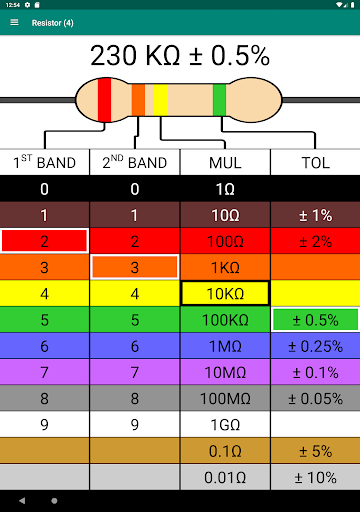
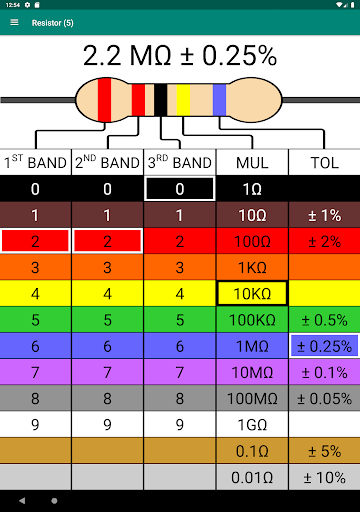
The application is an easy-to-use color code calculator for calculating the resistance of a resistor. The application supports color codes for 3, 4, 5, and 6-band resistors.
Resistor
A resistor is a component that is used in electrical circuits to limit the current flow. The resistance of a resistor is measured in Ohms (Ω). When a current (I) of one Ampere passes through a resistor with a voltage drop (U) of one Volt, the resistance of a resistor (R) corresponds with one Ohm. This ratio is represented by Ohm's law: R = U ÷ I.
Color code
The color codes on a resistor identifies the resistance, tolerance, and/or temperature coefficient of a resistor. Resistors come in variation with 3, 4, 5, or 6 colors bands. In the following, the meaning of each band is described for each type of resistor.
3-band resistor
1. The first band represents the first digit of the resistance value.
2. The second band represents the second digit of the resistance value.
3. The third band represents the multiplication factor of the resistance value.
4-band resistor
1. The first band represents the first digit of the resistance value.
2. The second band represents the second digit of the resistance value.
3. The third band represents the multiplication factor of the resistance value.
4. The fourth band represents the tolerance in percentage of the resistance value.
5-band resistor
1. The first band represents the first digit of the resistance value.
2. The second band represents the second digit of the resistance value.
3. The third band represents the third digit of the resistance value.
4. The fourth band represents the multiplication factor of the resistance value.
5. The fifth band represents the tolerance in percentage of the resistance value.
6-band resistor
1. The first band represents the first digit of the resistance value.
2. The second band represents the second digit of the resistance value.
3. The third band represents the third digit of the resistance value.
4. The fourth band represents the multiplication factor of the resistance value.
5. The fifth band represents the tolerance in percentage of the resistance value.
6. The sixth band represents the temperature coefficient of the resistance value.
In total, there are 12 different colors. The colors are black, brown, red, orange, yellow, green, blue, violet, grey, white, gold, and silver. The resistance of the resistor is determined by the colors of the bands.
What’s new
Support for Android 13


